A concentration printed on a skin care label is easy to compare. A clinical result is harder. In a 12-week randomized, double-blind acne study, a cream containing 2% salicylic acid plus 0.5% chloroxylenol produced lesion reductions close to those reported for 5% benzoyl peroxide gel. The cream also had fewer reported redness and photosensitivity adverse effects at the final visit. Those findings deserve attention, but they answer a narrower question than whether any 2% salicylic acid product works like benzoyl peroxide.
The experiment compared two complete topical treatments: different active ingredients in different vehicles. It did not isolate salicylic acid, establish formal equivalence, or test visible pore size. This analysis uses the indexed primary report abstracts for that trial and two related studies, together with available official FDA material. Reading them together reveals why formulation, blinding, follow-up length, and the way adverse effects are reported matter as much as the headline percentages.
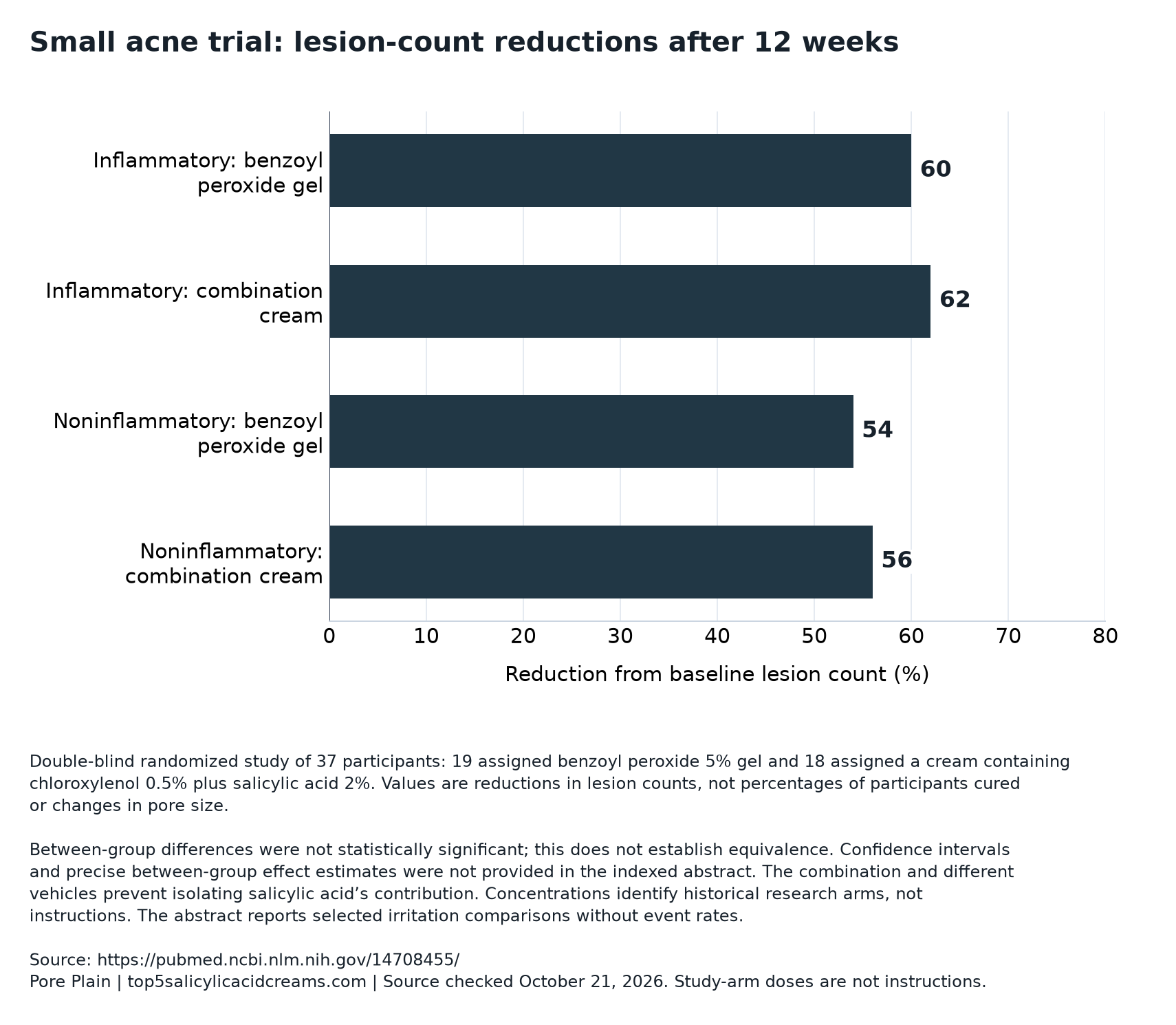
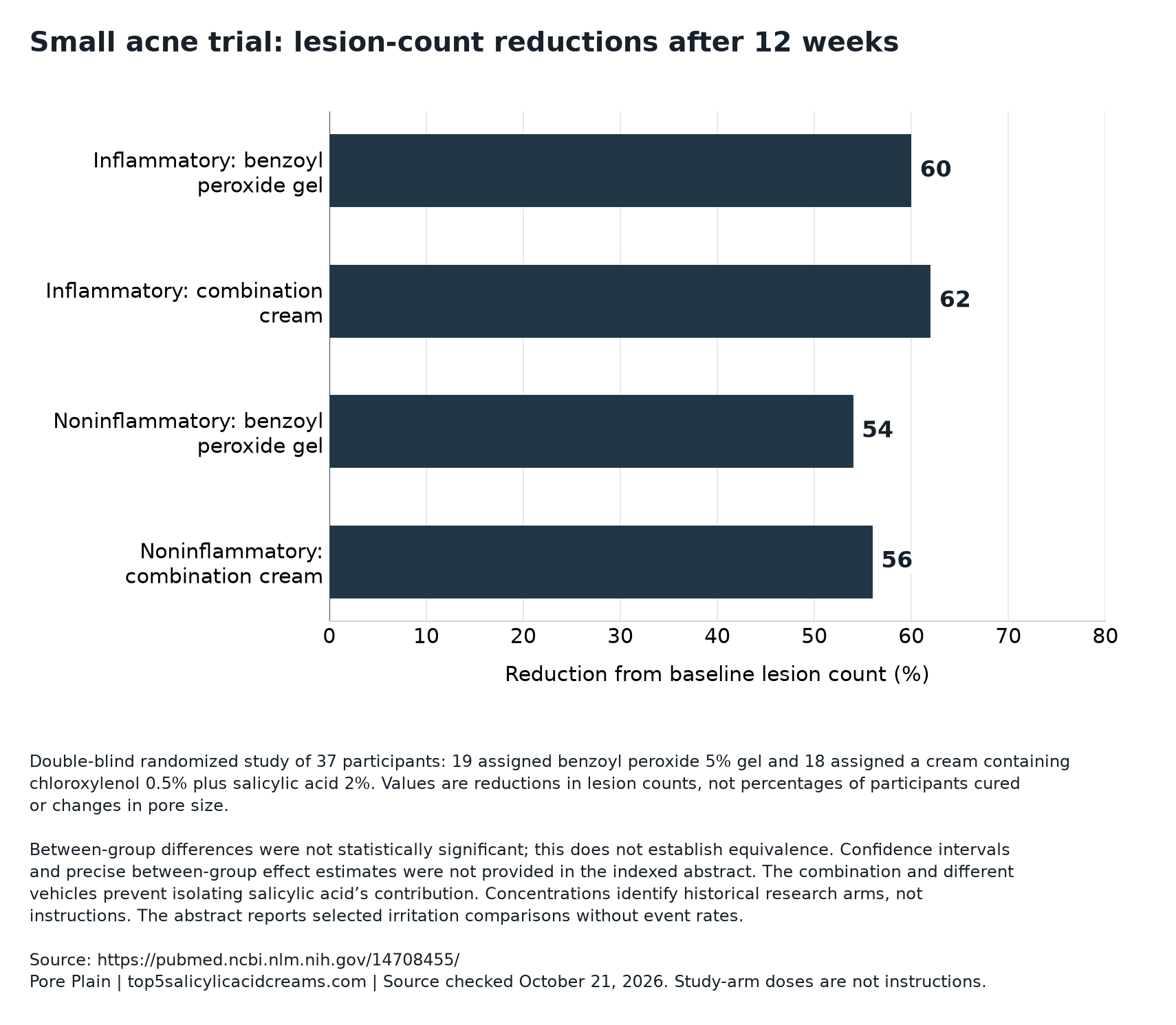
Download chart data (CSV)Download chart (PNG)
Study facts at a glance
Main comparison: Thirty-seven volunteers were randomized: 19 to 5% benzoyl peroxide gel and 18 to 0.5% chloroxylenol plus 2% salicylic acid cream for 12 weeks. [1]
Inflammatory lesions: Reported week-12 reductions were 60% with benzoyl peroxide and 62% with the combination cream. [1]
Noninflammatory lesions: Reported reductions were 54% and 56%, respectively; between-group lesion comparisons were not statistically significant. [1]
Tolerability finding: Redness and photosensitivity were significantly less frequent with the combination at week 12, but the abstract does not provide event counts or percentages. [1]
Regulatory distinction: The FDA acne monograph lists salicylic acid at 0.5–2%, but meeting a concentration range alone does not establish monograph conformity or individual product approval. [2]
Related reading: Salicylic acid: acne treatment or smoothing ingredient? · CoreAge Rx Pore Favor review
A comparison of two complete facial treatments
The main trial enrolled 37 volunteers with acne vulgaris and randomly assigned them to two groups. Nineteen received 5% benzoyl peroxide gel; 18 received a cream containing 0.5% chloroxylenol and 2% salicylic acid, identified in the report as Nisal cream. Participants applied their assigned topical treatment to the entire face twice daily. These details describe the experimental arms, not instructions for using other products.
Investigators performed clinical evaluations and lesion counts at baseline and at weeks 3, 6, 9, and 12. The abstract identifies the study as double-blind, but does not explain how masking was maintained between a cream and a gel. It also does not provide participant ages, detailed baseline severity, completion counts, or sponsor information. Those omissions limit assessment of generalizability and possible bias.
Lesion counts and adverse reactions were the central reported outcomes. The accessible abstract does not identify a single prespecified primary endpoint or provide a protocol. Consequently, the clearest description is a randomized comparison with repeated acne assessments—not a fully reconstructed trial whose endpoint hierarchy and analysis plan have been independently checked.
What the lesion percentages represent
At week 12, the benzoyl peroxide group had reported reductions of 60% in inflammatory lesions and 54% in noninflammatory lesions. Corresponding reductions with the combination cream were 62% and 56%. Inflammatory lesions include the papules and pustules discussed in the report; noninflammatory lesions include comedones, commonly described as blackheads and whiteheads.
Each comparison therefore favored the cream numerically by 2 percentage points. That is not the same as two additional people becoming clear, nor a 2% reduction in a person's probability of acne. These are group-level lesion-count results, and the abstract does not specify whether the reported percentages are means, medians, or another summary. It also supplies no confidence intervals.
An illustrative calculation helps separate counts from clearance: a 60% reduction from 20 lesions would leave eight, while a 62% reduction would leave 7.6 as a mathematical illustration. These are not observed participant counts. Different starting counts could yield different remaining burdens, and improvement in counted lesions does not establish that participants achieved clear skin.
| Outcome | Benzoyl peroxide 5% gel | Chloroxylenol 0.5% + salicylic acid 2% cream |
|---|---|---|
| Inflammatory lesions | 60% reduction | 62% reduction |
| Noninflammatory lesions | 54% reduction | 56% reduction |
| Between-group interpretation | No statistically significant lesion-count difference reported | A 2-percentage-point numerical advantage on each lesion category; equivalence not established |
Compare the options in top 5 salicylic acid creams & treatments or read Creams versus liquids and gels.
Close results do not establish equivalence
The abstract reports no statistically significant difference between treatments in reductions of papules and pustules or comedones. That finding means the analysis did not demonstrate a difference under its statistical criteria. It does not prove that the treatments have identical effects or that any clinically important difference has been excluded.
A formal equivalence study needs an acceptable difference defined in advance and an analysis showing that uncertainty stays within those limits. Neither an equivalence margin nor confidence intervals appear in the accessible report. With only 18 and 19 volunteers assigned to the arms, the precision of the treatment comparison is particularly important, yet cannot be quantified from the abstract.
The authors interpreted the treatments as similarly effective. A more bounded editorial interpretation is that both groups improved substantially and their reported reductions were close, without demonstrated superiority in lesion counts. The data remain compatible with uncertainty about differences that a larger, appropriately designed trial might resolve. Statistical nonsignificance is not a certificate of interchangeability.
The cream vehicle is part of the experiment
The combination arm changed more than the presence of salicylic acid. It included chloroxylenol and used a cream, whereas the comparator contained benzoyl peroxide in a gel. Any observed difference could reflect the active ingredients, the vehicles, their interactions, or other formulation characteristics. The study cannot allocate the outcome among those possibilities.
A salicylic-acid-only arm would have helped answer whether chloroxylenol contributed; matched vehicles would have helped separate vehicle effects. Those comparisons are not reported. The abstract describes a slightly stronger keratolytic effect with the cream—an effect related to shedding surface skin cells—but this does not establish why the clinical results occurred or identify one ingredient as responsible.
That distinction is central to understanding salicylic acid's acne and smoothing roles. It also explains why a wash-versus-leave-on comparison requires more than matching a percentage. This trial studied an entire-face leave-on cream, not a rinse-off cleanser, toner, compounded product, or an oral formulation. Its findings do not automatically transfer across those categories.
The tolerability signal has missing denominators
At week 12, the report found significantly fewer adverse effects of erythema, meaning redness, and photosensitivity with the combination cream. The reported P values were 0.0002 for erythema and 0.05 for photosensitivity. These are actual comparative safety findings, not merely an absence of reported problems.
However, the abstract does not state how many participants experienced either event, their severity, whether events caused discontinuation, or how symptoms evolved between visits. A P value is not a risk percentage. For example, 0.0002 cannot be translated into a 0.02% chance of redness, and it cannot supply an absolute reduction in adverse-event risk.
The defensible conclusion is narrower than calling the cream universally gentle: this particular comparison favored it for two reported adverse effects at the final visit. It does not establish that salicylic acid always causes less irritation than benzoyl peroxide. The broader distinction between expected local irritation and a reaction needing attention is addressed in the salicylic acid irritation guide.
An add-on trial found a different dryness tradeoff
A separate 12-week study enrolled 49 people with mild to moderate facial acne. This prospective, randomized, single-blind comparison examined salicylic acid added to clindamycin phosphate plus benzoyl peroxide versus the clindamycin–benzoyl peroxide regimen alone. It therefore asked about an addition to an antibiotic-containing treatment, not replacement of benzoyl peroxide with the chloroxylenol cream.
The salicylic acid addition favored inflammatory and total lesion reductions throughout the study weeks, and noninflammatory lesion reductions beyond two weeks. Patient and investigator global improvement scores also favored the addition at study end. However, the abstract provides no numerical effect sizes, confidence intervals, or salicylic acid concentration. Statistical significance alone cannot show how large the added benefit was.
Both regimens significantly reduced stratum corneum hydration, a measure of water in the outer skin layer. Mild to moderate transient dryness occurred significantly more often with added salicylic acid. Thus, improved lesion outcomes and increased dryness coexisted. This does not contradict the first trial: the ingredients, comparator, and formulation question were different. Nor does it provide a self-directed recipe for combining acne medicines.
| Study design | Comparison and follow-up | Main interpretation |
|---|---|---|
| 37 volunteers; randomized, double-blind | Chloroxylenol/salicylic acid cream versus benzoyl peroxide gel; 12 weeks | Close lesion reductions; fewer reported redness and photosensitivity events with the cream at week 12 |
| 49 enrolled; randomized, single-blind | Salicylic acid added to clindamycin plus benzoyl peroxide versus that regimen alone; 12 weeks | Lesion outcomes favored the addition, alongside more transient dryness; numerical benefit unavailable in abstract |
| 31 completers; randomized, open-label, split-face | Modified 2% salicylic acid cream versus benzoyl peroxide/adapalene gel; 28 days | No significant between-side lesion differences; short pilot, not proof of equivalence |
A split-face pilot is not a replication
Another randomized study applied 2% supramolecular salicylic acid cream to one side of the face and a benzoyl peroxide–adapalene gel to the opposite side for 28 days. It was open-label and single-center, with 31 completers. Those are 31 people with paired observations, not 62 independent participants. The enrollment denominator and attrition details are unavailable in the indexed abstract.
Reported inflammatory lesion reductions were 47.9% with the modified salicylic acid formulation and 49.8% with the comparator. Noninflammatory reductions were 43.1% versus 42.7%, and total reductions were 44.1% versus 45.6%. All between-side lesion comparisons were nonsignificant. Measured hydration, transepidermal water loss, brightness, and erythema also showed no significant between-side differences; that does not mean values remained unchanged over time.
The abstract contains a concentration discrepancy: its title and methods identify 0.1% adapalene with 5% benzoyl peroxide, while the objectives also say 0.01% adapalene. That conflict cannot be resolved from the abstract alone. The separate split-face study analysis examines this pilot more closely. Its modified formulation, shorter duration, and open-label design prevent treating it as confirmation of the blinded cream trial.
Fewer comedones do not measure smaller pores
For a pore-focused reader, the noninflammatory lesion results are relevant but easy to overextend. Comedones are acne lesions; their counts are not measurements of pore diameter. A reduction in blackheads or whiteheads can occur without demonstrating permanent structural change in pores. None of the three abstracts establishes pore closure, a precise pore-size benefit, scar improvement, or complete clearance.
Even the split-face study's skin brightness and redness instruments answer different questions from pore size. Transepidermal water loss measures water escaping through the skin and is used as a barrier-related measure; it does not directly measure visible pores. Nonsignificant between-side instrument results cannot be converted into claims of no irritation or long-term barrier protection.
FDA's cosmetic BHA discussion describes salicylic acid in an exfoliation context, but that background is not a clinical trial of pore appearance. The practical interpretation is to match claims to measured outcomes: these studies primarily inform acne lesion changes and selected tolerability measures, not every cosmetic promise associated with an exfoliating product.
FDA ingredient ranges are not product endorsements
FDA's topical acne monograph lists salicylic acid at 0.5–2% and benzoyl peroxide at 2.5–10%. These are regulatory conditions for relevant OTC acne drug products, not comparative efficacy rankings. Conformity requires meeting all applicable conditions, not just displaying an ingredient percentage within the range. The monograph is not individual approval of every product carrying those concentrations.
Its labeling provisions warn that combining topical acne medicines can increase irritation and dryness. Benzoyl peroxide also has specific warnings involving sensitivity, sunlight, eye and mucosal contact, and fabric bleaching. These official cautions provide context for real-world tolerability, but they do not identify which ingredient or vehicle caused an event in the small trial.
The Drug Facts reading guide helps distinguish an actual product label from a research regimen. FDA's cosmetic BHA page serves another purpose: its historical discussion of an industry safety assessment is neither product approval nor proof that an old research program remains ongoing today. Acne-drug and cosmetic evidence should retain their separate meanings.
Safety reports and commercial comparisons need separate evidence
FDA has also warned about rare serious hypersensitivity reactions to some OTC acne products containing salicylic acid or benzoyl peroxide. Its historical review identified 131 reports through January 28, 2013, including 58 hospitalizations and 50 categorized as anaphylactic. These selected reports lack a user-exposure denominator and cannot establish incidence or compare the two ingredients' risks.
The causal ingredient was not established: an active ingredient, inactive ingredient, or both could have contributed. FDA advises stopping the product and seeking emergency care for throat tightness, breathing difficulty, faintness, or swelling of the eyes, face, lips, or tongue. Such symptoms are distinct from ordinary dryness. A small-area sensitivity check does not guarantee that a later reaction will not occur.
Editorial interpretation: a clinical paper should not substitute for checking a commercial service's documented terms. Readers considering a service can consult the CoreAge Rx review or Likeness Rx review for that documentary task. These links do not establish that either service supplies the studied formulation, treats the studied population, or reproduces its outcomes; the trial provides no evidence about their contracts or care.
What this evidence supports
The blinded 12-week trial offers a useful but limited signal: a particular chloroxylenol–salicylic acid cream produced lesion reductions close to those of 5% benzoyl peroxide gel and favored the cream on two reported tolerability outcomes. The stronger conclusion is about formulation-specific performance, not ingredient interchangeability. The add-on trial shows that better acne counts can accompany more dryness, while the split-face pilot raises a separate question about a modified preparation. More decisive evidence would require larger comparisons, clearly defined primary outcomes, confidence intervals, transparent adverse-event counts, and designs that separate active ingredients from vehicles.
Research access and limitations
The clinical analysis is based on indexed primary study abstracts, not complete protocols, supplements, or independently reviewed full articles. Detailed statistical methods, confidence intervals, sponsorship, and several population and adverse-event details were unavailable in those abstracts. Official FDA material supplies regulatory and safety context, not missing trial data or product-specific efficacy evidence.
Questions about the evidence
Did the 37-person trial show that salicylic acid alone matched benzoyl peroxide?
No. The experimental cream contained both salicylic acid and chloroxylenol, and its vehicle differed from the benzoyl peroxide gel. Without a salicylic-acid-only arm or matched-vehicle comparisons, the result belongs to the whole formulation. Close group-level lesion reductions also do not establish formal equivalence. [1]
Can the reported percentages tell me how many participants became clear?
No. A percentage reduction in lesions describes a different outcome from the percentage of participants achieving clearance. The abstract does not report a clearance threshold or clearance counts. Baseline lesion burden and individual responses would be needed to understand how the group-level reductions translated into remaining acne for particular participants. [1]
Why did adding salicylic acid increase dryness in the other trial?
The study documented more mild to moderate transient dryness, but its abstract does not establish the mechanism. It tested an addition to clindamycin plus benzoyl peroxide, not the chloroxylenol cream. Different combination and vehicle effects are plausible explanations, not demonstrated causes. Its better lesion outcomes therefore came with a distinct tolerability tradeoff. [5] [1]
Does the split-face trial prove that a regular 2% BHA product has the same effect?
No. It tested a modified supramolecular salicylic acid cream for 28 days, with open-label assessments and 31 completers. A shared concentration does not make unrelated formulas equivalent. Its nonsignificant comparisons also leave uncertainty about clinically meaningful differences, especially because confidence intervals are unavailable in the abstract. [6]
Does inclusion in the FDA acne monograph mean a product was individually approved?
No. The monograph establishes conditions under which relevant OTC acne drugs can be marketed; concentration is only one condition. It is not a product-specific clinical endorsement. The actual label remains important, including warnings about dryness, irritation, and use with other topical acne medicines. [2]
Sources and verification
Official pages establish product facts and provider claims. Clinical and regulatory sources answer separate evidence questions. Article checked October 21, 2026; individual source dates appear below. No medical reviewer is credited for this article.
- Comparison of chloroxylenol 0.5% plus salicylic acid 2% cream and benzoyl peroxide 5% gel in the treatment of acne vulgaris: a randomized double-blind study. ↗ · Checked October 21, 2026 · Indexed primary study abstract
- FDA OTC monograph M006: topical acne drug products ↗ · Checked October 21, 2026 · Official six-page administrative order, all sections read
- FDA: beta hydroxy acids in cosmetics ↗ · Checked October 21, 2026 · Official FDA consumer background page, complete text read
- FDA safety communication: serious hypersensitivity to some OTC acne products ↗ · Checked October 21, 2026 · Official FDA Spanish communication; entire safety notice and data summary read
- Efficacy of the addition of salicylic acid to clindamycin and benzoyl peroxide combination for acne vulgaris. ↗ · Checked October 21, 2026 · Indexed primary study abstract
- Efficacy and safety of 2% supramolecular salicylic acid compared with 5% benzoyl peroxide/0.1% adapalene in the acne treatment: a randomized, split-face, open-label, single-center study. ↗ · Checked October 21, 2026 · Indexed primary study abstract