A salicylic acid percentage tells only part of an acne treatment’s story. In a 28-day study, researchers compared a 2% supramolecular salicylic acid cream with a gel containing benzoyl peroxide and adapalene, applying the treatments to opposite sides of each participant’s face. Both sides showed substantial reported reductions in acne lesions. The interesting question is not simply which percentage was larger, but what this small, closely paired experiment establishes about the actual formulations.
The trial had 31 completers, not 62 independent patients. It was randomized but open-label, and its published abstract contains a discrepancy in the adapalene concentration. This analysis uses the indexed primary report abstracts and available official FDA material; it does not represent a review of inaccessible full protocols or supplements. The findings support further investigation of the modified cream, while leaving important questions about comparative effectiveness, irritation, durability, and ordinary retail salicylic acid products unresolved.
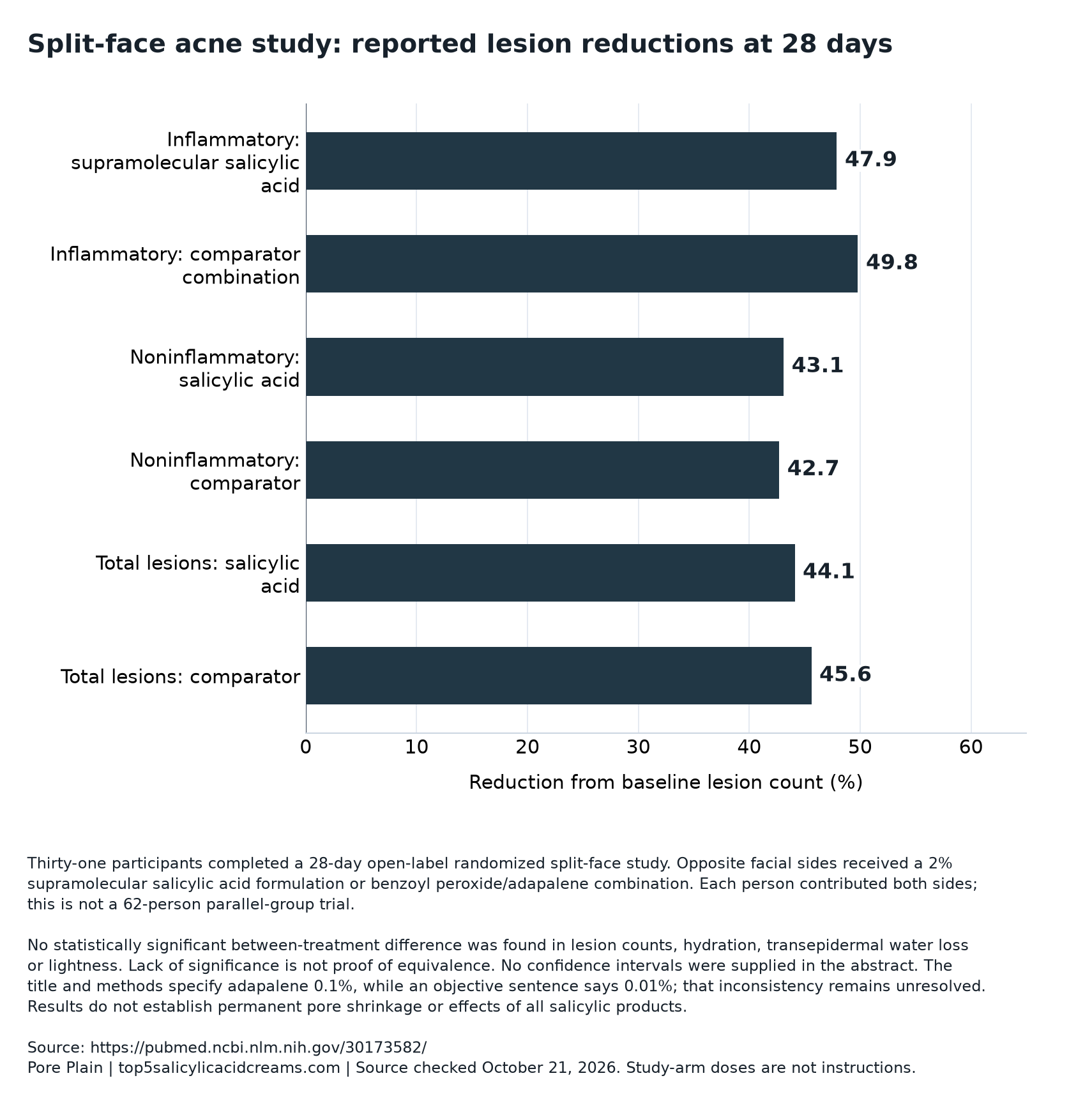
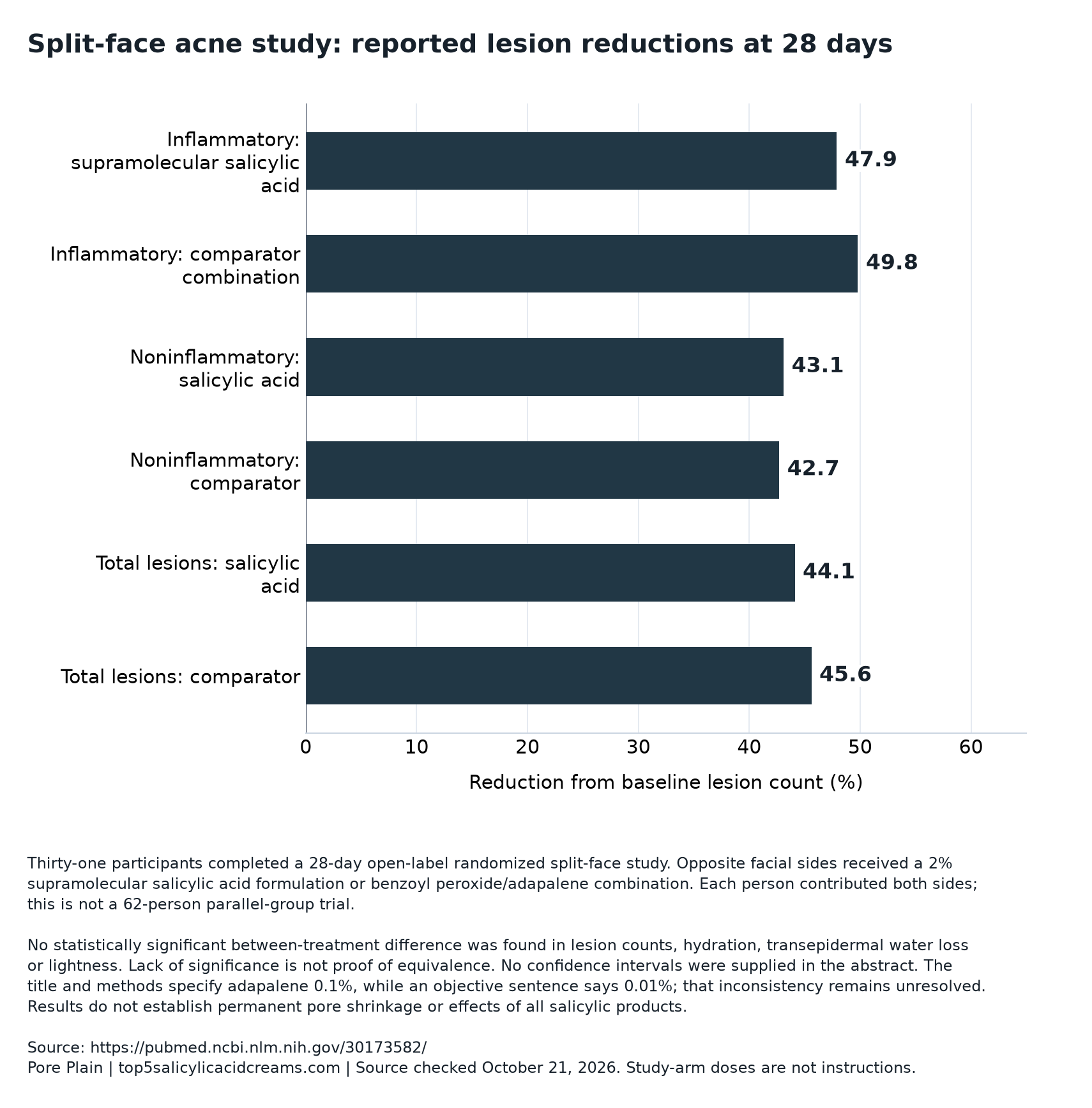
Download chart data (CSV)Download chart (PNG)
Study facts at a glance
Study population: Thirty-one people with mild to moderate acne completed a randomized, open-label, single-center, split-face trial lasting 28 days. [1]
Treatments compared: Topical 2% supramolecular salicylic acid cream versus a gel identified in the title and methods as 5% benzoyl peroxide plus 0.1% adapalene; the objectives text inconsistently says 0.01% adapalene. [1]
Total lesion results: Reported total lesion reductions were 44.1% and 45.6%, respectively, without a statistically significant between-treatment difference. [1]
Skin measurements: Between-side comparisons of hydration, water loss, brightness, and erythema were not statistically significant; that does not establish unchanged skin over time or absence of irritation. [1]
Formulation matters: The studied salicylic acid was a modified preparation. Neither its concentration nor the OTC acne monograph makes other 2% products clinically interchangeable with it. [1] [2]
Related reading: Salicylic acid: acne treatment or smoothing ingredient? · CoreAge Rx Pore Favor review
Why one face supplied a paired comparison
The researchers enrolled people with mild to moderate facial acne and randomly assigned 2% supramolecular salicylic acid cream to one facial side, with the benzoyl peroxide–adapalene gel on the other. Investigators counted lesions and evaluated side effects at baseline, day 14, and day 28. They also measured skin water content, transepidermal water loss, and skin color indicators at those visits. The abstract does not identify a single prespecified primary endpoint among these assessments.
A split-face design lets each participant serve as their own comparison. Age, many environmental exposures, and much of an individual’s acne tendency are shared across the two treatment areas. That can make a paired study informative without recruiting two entirely separate groups. It does not guarantee identical starting lesion counts on both sides or eliminate every source of bias.
The reported sample was 31 completers. Counting two facial sides per person does not create 62 independent patients: the sides remain related observations. The abstract does not provide the original enrollment denominator, so the number who withdrew and the reasons for withdrawal cannot be reconstructed. That missing information matters when judging whether the final results represent everyone who initially entered.
The comparison involved formulations, not isolated percentages
The salicylic acid intervention was a 2% supramolecular preparation, described as modified salicylic acid, delivered as a cream. The opposite side received a gel combining two acne drugs. These are treatment packages: active ingredients, their concentrations, and the formulation carrying them. The study does not isolate whether any observed difference arose from an active ingredient, the cream-versus-gel vehicle, or another formulation feature.
There is also a reporting inconsistency worth keeping visible. The title and methods identify the comparator as 5% benzoyl peroxide plus 0.1% adapalene. The objectives sentence instead includes 0.01% adapalene, despite also displaying the 0.1% notation. Using 0.1% to describe the title and methods is reasonable, but it is not independent confirmation from the full paper.
These concentrations identify study arms, not instructions for assembling a regimen. They also do not establish that an ordinary 2% liquid, cleanser, gel, or compounded preparation will reproduce the result. The salicylic acid explainer provides ingredient context, while the wash-versus-leave-on guide helps frame why delivery format deserves attention rather than being treated as packaging.
Compare the options in top 5 salicylic acid creams & treatments or read Creams versus liquids and gels.
What the day-28 lesion reductions show
At day 28, the reported group-level reductions were numerically close across all three lesion categories. Inflammatory lesions included papules and pustules; noninflammatory lesions represent the noninflamed acne category. Total lesion counts combined categories rather than measuring an entirely separate skin property. The abstract does not specify whether these percentages are means, medians, or another summary, so they should remain described as reported reductions.
The numerical separation was 1.9 percentage points for inflammatory lesions in favor of the comparator, 0.4 percentage points for noninflammatory lesions in favor of salicylic acid, and 1.5 percentage points for total lesions in favor of the comparator. These are differences between reported percentage reductions—not differences in the proportion of patients cured.
For a purely illustrative calculation, a 44.1% reduction from 100 lesions would leave 55.9 lesions in a group-level arithmetic example. That is not an actual participant’s count, and lesion counts in one person are whole numbers. The example shows why a substantial reduction still falls well short of clearance. Baseline absolute counts are unavailable here, preventing a reliable translation into the actual number of lesions removed.
| Lesion category | 2% supramolecular salicylic acid cream | 5% benzoyl peroxide + 0.1% adapalene gel |
|---|---|---|
| Inflammatory lesions | 47.9% reduction | 49.8% reduction |
| Noninflammatory lesions | 43.1% reduction | 42.7% reduction |
| Total lesions | 44.1% reduction | 45.6% reduction |
Similar results are not a formal equivalence finding
The abstract reports that the lesion-count comparisons all had P values greater than 0.05. In plain language, the analysis did not detect a statistically significant difference between treatments. That is compatible with genuinely close effects, but it is also compatible with a study too small or imprecise to detect a meaningful difference. A nonsignificant result alone cannot distinguish those possibilities.
Formal equivalence or noninferiority requires more than two nearby percentages. Researchers ordinarily define an acceptable difference in advance and assess the estimated treatment difference, including its uncertainty, against that boundary. The accessible abstract supplies neither a prespecified equivalence margin nor confidence intervals for these comparisons. It therefore does not support declaring the cream an established equivalent replacement.
This distinction is practical rather than semantic. The 1.5-percentage-point gap in total lesion reduction describes the observed summaries; it does not tell readers the range of plausible underlying differences. Without confidence intervals and fuller statistical methods, the precision of that gap cannot be assessed. The authors’ description of the work as a pilot study fits a signal that merits confirmation rather than a definitive ranking.
Randomization helped, but treatment was not blinded
Random assignment of facial sides reduces the chance that investigators systematically gave one treatment to the more favorable side. Open-label treatment means the assignments were not concealed through blinding. Those are separate design features: a study can be randomized while participants and investigators still know which treatment is being used.
Lesion counting is more concrete than a broad impression of improvement, but it still requires identifying and classifying lesions. Knowledge of treatment could influence assessments or participant behavior. The abstract does not establish that an independent blinded assessor checked counts, and such protection should not be assumed. Instrument-based measurements add useful information without solving every possible bias in the clinical assessment.
The 28-day duration also limits the question being answered. It captures early treatment response, not sustained control, recurrence after treatment, or long-term tolerability. A single center and a small completer sample further narrow generalizability. Age distributions and subgroup results are unavailable in the abstract, so the findings cannot be assigned specifically to older adults, particular skin types, or other unreported groups.
Hydration and water loss answered narrower questions
Skin hydration measurements assess water content, while transepidermal water loss, or TEWL, measures water escaping through the skin. The trial also assessed L*, a lightness indicator, and a*, an indicator related to redness. None of the reported between-side comparisons reached statistical significance. These measurements broaden the study beyond lesion counts, but they are not interchangeable measures of comfort or overall skin health.
Most importantly, a nonsignificant difference between sides does not mean that values stayed unchanged from baseline. Both sides could have changed similarly, or a difference could have remained undetected. The abstract does not provide the numerical trajectories or confidence intervals needed to distinguish those possibilities. It also does not provide detailed adverse-event frequencies, despite describing side-effect assessments.
The correct conclusion is therefore narrower than either “no barrier damage” or “no irritation.” The measured sides were not statistically distinguishable on the reported indicators within this short study. Questions about stinging, peeling, individual intolerance, and cumulative irritation remain incompletely answered. The irritation guide offers context for separating treatment burden from the appearance of fewer acne lesions.
Other trials tested different salicylic acid questions
Two other randomized studies help contextualize the findings, but neither replicates this modified cream comparison. One tested a cream combining chloroxylenol and salicylic acid against benzoyl peroxide. Another tested the addition of salicylic acid to an existing clindamycin–benzoyl peroxide regimen. Their longer follow-up and different blinding arrangements are informative, but their treatment effects cannot be attributed to salicylic acid alone.
In the 37-volunteer double-blind study, week-12 inflammatory lesion reductions were reported as 62% with the combination cream and 60% with benzoyl peroxide; noninflammatory reductions were 56% and 54%. Between-group differences were nonsignificant. Erythema and photosensitivity were significantly less frequent with the combination at week 12, although the abstract does not provide event frequencies.
The 49-patient add-on study reported greater lesion-count improvement with added salicylic acid, alongside more mild to moderate transient dryness. Its abstract omits the salicylic acid concentration and numerical treatment-effect estimates. These results argue against a universal claim that salicylic acid combinations are always gentler. The separate combination-trial analysis examines why ingredients and vehicles complicate comparisons.
| Study design and sample | Treatment comparison | Main interpretive distinction |
|---|---|---|
| 28 days; randomized, open-label, split-face; 31 completers | 2% modified salicylic acid cream versus benzoyl peroxide–adapalene gel | Paired short-term comparison; nonsignificant differences do not establish equivalence |
| 12 weeks; randomized, double-blind; 37 volunteers | 0.5% chloroxylenol + 2% salicylic acid cream versus 5% benzoyl peroxide gel | Combination treatment, not salicylic acid alone; fewer reported erythema and photosensitivity events at week 12 |
| 12 weeks; randomized, single-blind; 49 enrolled | Salicylic acid added to clindamycin–benzoyl peroxide versus the regimen without that addition | Reported greater lesion improvement but more transient dryness; salicylic acid concentration absent from abstract |
Fewer comedones do not prove permanently smaller pores
Noninflammatory acne lesions and visible pores are related consumer concerns, but they are not the same endpoint. The split-face trial counted lesions; it did not report a validated pore-size measurement, permanent narrowing of follicular openings, or pore closure. Its lightness and redness readings also cannot substitute for measurements of pore dimensions.
The same boundary applies to scarring, texture, and cosmetic satisfaction. A reduction in lesions might matter visibly to a participant, but the abstract does not quantify those additional outcomes or establish how closely they followed lesion counts. The absence of a pore endpoint is not evidence that nothing about appearance changed; it means the specific pore claim was not tested.
FDA’s cosmetic BHA discussion provides exfoliation context, while the acne monograph addresses uses involving acne lesions, blackheads, and whiteheads. Neither establishes permanent pore shrinkage. For readers weighing a pore-focused label, the Drug Facts guide helps distinguish labeled acne uses from broader cosmetic language. The clinically measured outcome should remain the anchor.
Regulatory concentration ranges do not erase safety differences
FDA’s topical acne monograph lists salicylic acid at 0.5–2% and benzoyl peroxide at 2.5–10% among permitted active-ingredient conditions. Compliance requires all applicable conditions, not just a matching percentage. The monograph is not a comparative trial or a product-specific approval, and it does not establish that the modified research cream and a marketed product have identical effects.
The labeling framework warns that combining topical acne medicines can increase dryness and irritation. Benzoyl peroxide carries additional warnings involving sensitivity, sunlight, eye or mucosal contact, and fabric bleaching. These are relevant treatment burdens even when lesion counts improve. The short split-face report does not provide enough adverse-event detail to calculate comparative rates of these problems.
Ordinary local irritation also differs from rare serious hypersensitivity. FDA advises stopping the product and seeking emergency care for throat tightness, breathing difficulty, faintness, or swelling of the eyes, face, lips, or tongue. Its historical reports do not supply an exposure denominator, so they cannot establish incidence. The responsible ingredient could be active, inactive, or both; small-area sensitivity checks do not guarantee protection.
What would make the next study more decisive
A larger trial could clarify whether the close lesion-count reductions persist with more precise estimates. Useful reporting would include starting counts, the original enrollment denominator, withdrawals, adherence, prespecified endpoints, and confidence intervals for paired treatment differences. Longer follow-up would address whether an early response becomes sustained control and whether irritation changes with continued exposure.
Blinded outcome assessment would strengthen confidence in lesion classification, even if visibly different formulations made full participant blinding difficult. A formal equivalence question would require an advance margin and suitable analysis rather than reliance on nonsignificant P values. Detailed adverse-event counts and patient-reported tolerability would complement instrument readings. Funding and sponsor information were unavailable in the accessed abstract, leaving that context unresolved.
Editorial interpretation: a product or care contract should be judged on its own documentation, not credited with another formulation’s study results. Readers can use the CoreAge Rx review or Likeness Rx review to check documented terms separately. Those links do not establish that either provider offers the studied formulation, provides condition-specific care, or achieves these outcomes.
What this evidence supports
This pilot study provides a formulation-specific signal: over 28 days, a modified salicylic acid cream produced reported lesion-count reductions close to those of a benzoyl peroxide–adapalene gel in 31 completers. Its paired randomized design is useful, but open-label assessment, short follow-up, missing confidence intervals, and incomplete adverse-event reporting limit the conclusion. The most defensible reading is evidence supporting a larger, better-characterized comparison—not proof of equivalent treatments, absence of irritation, permanent pore shrinkage, or results transferable to any product bearing a 2% label.
Research access and limitations
The clinical analysis relies on indexed primary study abstracts rather than inaccessible full articles, protocols, or supplements. Official FDA material supplies regulatory and safety context. Baseline absolute lesion counts, full statistical methods, enrollment and attrition details, confidence intervals, detailed adverse-event frequencies, and funding information were unavailable for the split-face study.
Questions about the evidence
Did salicylic acid work as well as the benzoyl peroxide–adapalene gel?
The reported reductions were close, and the study did not detect statistically significant between-treatment differences. That supports a preliminary finding of similar observed short-term responses. It does not establish formal equivalence, because the abstract lacks an equivalence margin and confidence intervals. The comparison also applies to the modified cream tested, not every salicylic acid product. [1]
Why is the sample 31 rather than 62?
Thirty-one people completed treatment on two facial sides each. Those sides are paired observations within the same individuals, not independent patients. Shared characteristics are a strength of the design, but doubling the count of treated areas does not double the number of independent participants. The abstract does not disclose how many people originally enrolled. [1]
Was the adapalene concentration 0.01% or 0.1%?
The title and methods identify 0.1% adapalene with 5% benzoyl peroxide. The objectives text inconsistently includes 0.01%. This article attributes 0.1% to the title and methods while preserving the discrepancy. The accessible evidence does not permit an independent full-paper resolution, and the inconsistency should not be silently corrected. [1]
Do the skin measurements show that neither treatment caused irritation?
No. Hydration, water loss, lightness, and redness did not differ significantly between facial sides. That is different from demonstrating unchanged values over time or no irritation in any participant. Detailed adverse-event frequencies were unavailable. A separate salicylic acid add-on trial reported more transient dryness, illustrating why tolerability depends on the particular regimen. [1] [5]
Can a retail 2% BHA product claim this study’s results?
A shared percentage alone is insufficient. The tested intervention was a modified supramolecular cream, not a generic category of all 2% BHA products. The study provides no direct evidence for a particular retail cleanser, liquid, compounded product, or provider formulation. FDA’s monograph concentration range supplies regulatory context, not proof of clinical interchangeability. [1] [2]
Sources and verification
Official pages establish product facts and provider claims. Clinical and regulatory sources answer separate evidence questions. Article checked October 21, 2026; individual source dates appear below. No medical reviewer is credited for this article.
- Efficacy and safety of 2% supramolecular salicylic acid compared with 5% benzoyl peroxide/0.1% adapalene in the acne treatment: a randomized, split-face, open-label, single-center study. ↗ · Checked October 21, 2026 · Indexed primary study abstract
- FDA OTC monograph M006: topical acne drug products ↗ · Checked October 21, 2026 · Official six-page administrative order, all sections read
- FDA: beta hydroxy acids in cosmetics ↗ · Checked October 21, 2026 · Official FDA consumer background page, complete text read
- Comparison of chloroxylenol 0.5% plus salicylic acid 2% cream and benzoyl peroxide 5% gel in the treatment of acne vulgaris: a randomized double-blind study. ↗ · Checked October 21, 2026 · Indexed primary study abstract
- Efficacy of the addition of salicylic acid to clindamycin and benzoyl peroxide combination for acne vulgaris. ↗ · Checked October 21, 2026 · Indexed primary study abstract
- FDA safety communication: serious hypersensitivity to some OTC acne products ↗ · Checked October 21, 2026 · Official FDA Spanish communication; entire safety notice and data summary read